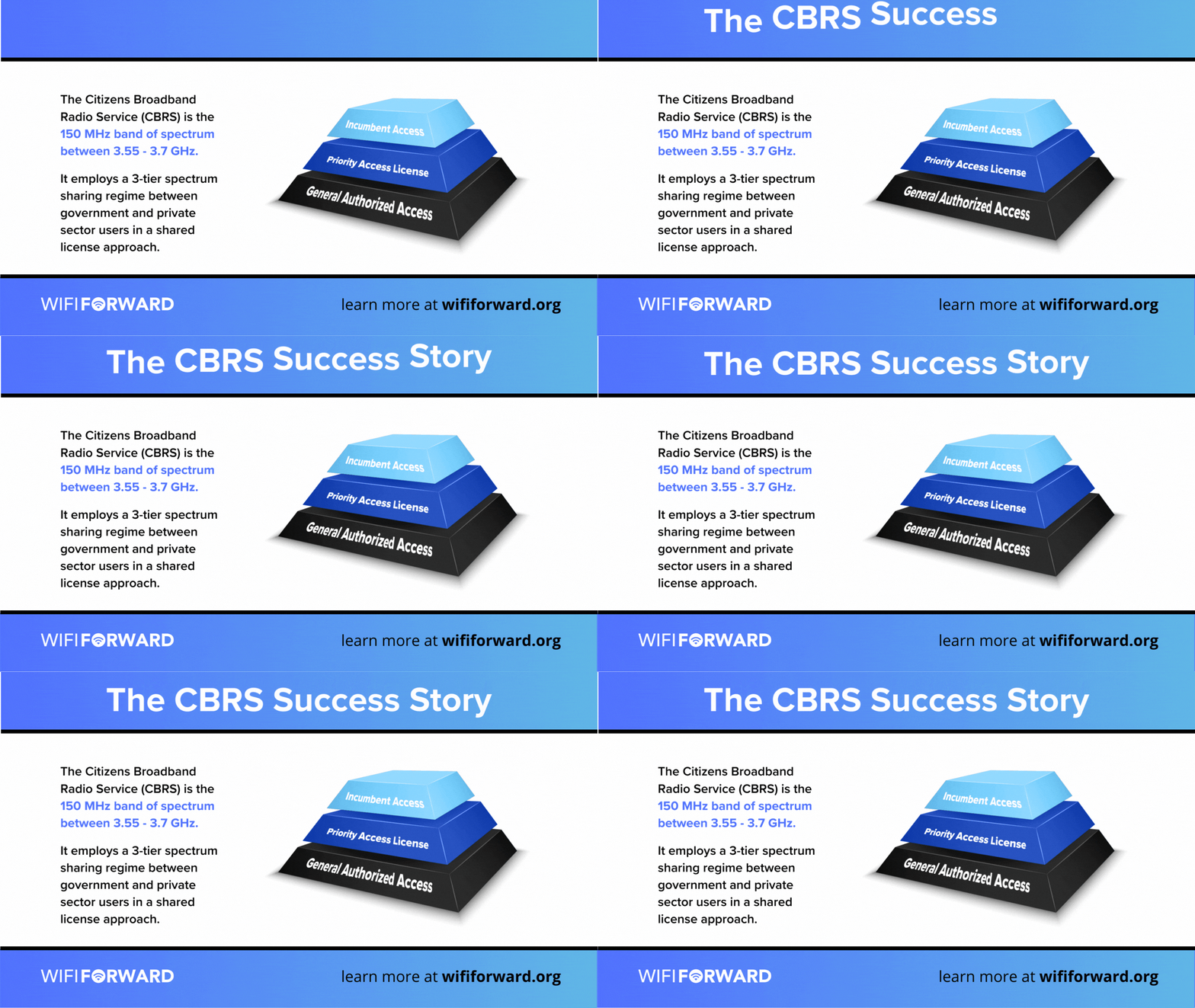
The Citizens Broadband Radio Service (CBRS) is the 150 MHz band of spectrum between 3.55-3.7 GHz. It employs a 3-tier spectrum sharing regime between government and private sector users in a shared license approach. This has significant benefits below: Read More “The CBRS Success Story”
Getting back to our regularly scheduled FrequencyPULSE with this week’s question: How does the success in the CBRS band impact the future of spectrum policy and the look ahead to the next bands in the spectrum pipeline?
Read More “How does the success in the CBRS band impact the future of spectrum policy and the look ahead to the next bands in the spectrum pipeline?”
Unlicensed and shared spectrum are proven solutions that deliver more competition, more 5G innovation, more US jobs, more voices and more connections. In 2021 alone, Wi-Fi boosted the U.S. economy by $995 billion — $177 billion more than was originally expected — and contributed 3.2 million jobs to the global economy. The wireless industry touts the economic benefits of licensed spectrum, but those benefits often do not extend to rural and underserved populations, as the carriers’ control of spectrum through exclusive-use licensing allows them to focus on serving areas with a high return on investment. The country is running out of spectrum, and a remarkably broad swath of companies and organizations — representing manufacturing, automotive, agriculture, energy, retail, commercial real estate, communications, media and supply chain industries, as well as schools, libraries, and civil society groups – support an inclusive approach to spectrum policy. So why do the three dominant mobile carriers oppose unlicensed and shared spectrum? To undermine competition and innovation. Read More “WifiForward Statement on CTIA Economic Study”
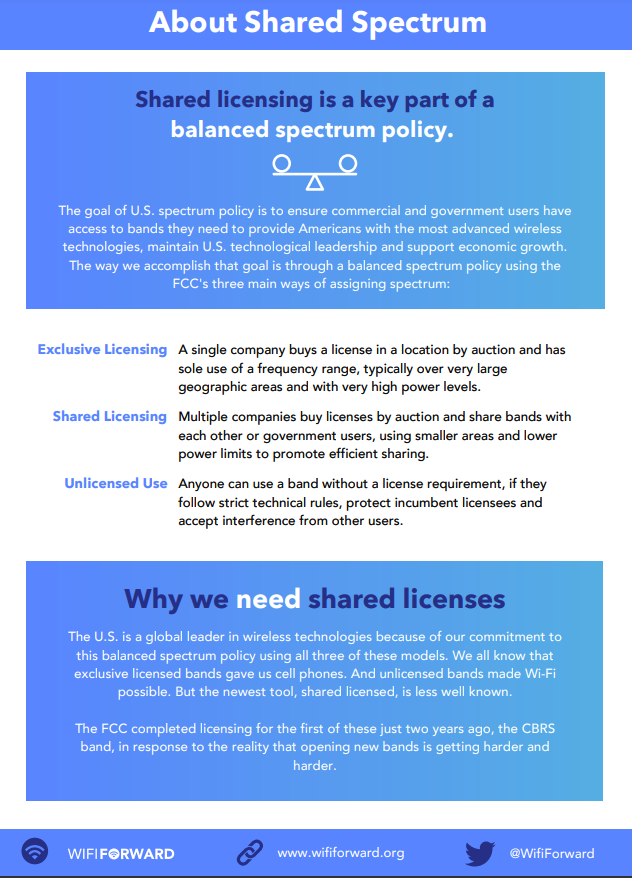
If you’re reading this, you’re either already familiar with wireless communications and spectrum regulation, or you’re a relatively inexperienced newcomer looking for more information regarding shared, licensed and unlicensed spectrum.
Read More “Basic Explainer: What Is Spectrum?”
The study released today by CTIA and Recon Analysis about CBRS uses cherry-picked data and overlooks robust success across many different industries. Read More “WifiForward’s Response to CTIA’s CBRS Study”
A new season of FrequencyPULSE begins!
This week’s timely question: As the 118th Congress is set to begin, what do members — new and established — need to know about balanced spectrum policy? Read More “As the 118th Congress is set to begin, what do members — new and established — need to know about balanced spectrum policy?”
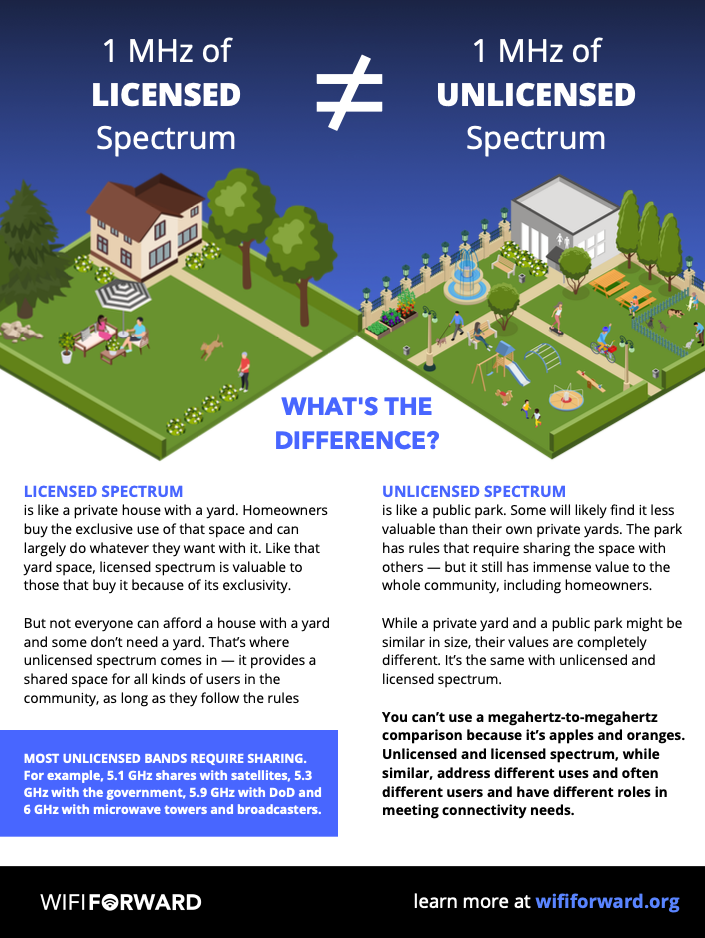
You may have been wondering what licensed and unlicensed spectrum mean in terms of value.
We’re here with a new visual aid to show that 1 MHz of licensed spectrum is not equal to 1 MHz of unlicensed spectrum. But what’s the difference? Read More “Apples and Oranges: The Value of Licensed and Unlicensed Spectrum”
Today, the FCC took another crucial step forward in making the economic and innovative potential of Wi-Fi 6E a reality, while laying the groundwork for Wi-Fi 7. This public notice on automated frequency coordination (AFC) testing and public trials in the 6 GHz band is the next major milestone, ensuring that Wi-Fi 6E devices will soon be able to take advantage of even greater utilization of this band. The 6 GHz band and the implementation of AFCs will unleash innumerable new use cases for the next generation of Wi-Fi. As we search for ways to share our crowded airwaves, database technologies like AFCs can play an essential role. WifiForward is pleased to see the FCC moving this process forward.
Read More “WifiForward on the FCC’s Public Notice on 6 GHz AFCs”
Virtual work is here to stay, according to a recent study from Deloitte of approximately 2,000 consumers in Q1 of 2022. Remote work has shifted from an occasional perk to a preferred option, motivating many former office workers to seek companies supporting hybrid or all-virtual environments. Read More “Looking to the Future of Remote Work”