
Attendees Saw Firsthand How Wi-Fi Connectivity Powers Soccer, Stadiums, and Streaming Services
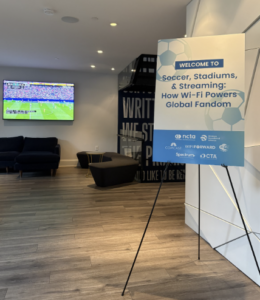
Washington, DC — This week, policymakers and industry leaders gathered to celebrate World Wi-Fi Day and highlight how Wi-Fi powers global sporting events, from supporting packed stadiums to high-demand streaming at a large scale. Hosted at the Consumer Technology Association’s (CTA) Innovation House on Capitol Hill, the event featured a hands-on demonstration from Amazon, showcasing how their eero devices eliminate connectivity challenges to enhance the fan experience.


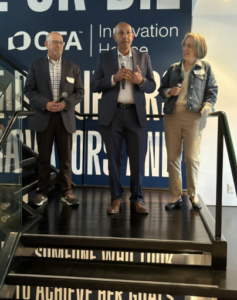
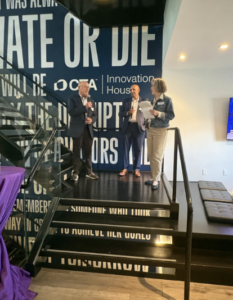
Jim Florwick, Principal Technical Marketing Engineer at Cisco, and Rajat Ghai, Vice President of Xfinity Wi-Fi Engineering at Comcast, both discussed the importance of Wi-Fi in supporting large-scale sporting events, including the need for reliable connection in crowded stadiums and the ability to deliver uninterrupted streaming to millions of viewers around the world.
When discussing the Wi-Fi capabilities and the convenience it provides to fans at the Philadelphia sports complex, Ghai said, “We actually saw amazing performance once we deployed 6 GHz… The part where you need connectivity the most is when the game ends, and 70,000 people are pouring out, you want to call an Uber and tell Uber where to pick you up, or when you want to figure out where your friends are… Nothing else will work, except for your apps that are working on 6 GHz.”
When asked about how Wi-Fi is integrated and used in stadiums, he added, “It [the stadium] is all on Wi-Fi. The security, tickets… the NHL actually mandates a separate Wi-Fi network.”
When discussing traffic and Wi-Fi use in stadiums, Florwick mentioned, “We’ve been able to stay ahead with the technology… the applications can do a lot more now. It [Wi-Fi] works so well everywhere, even large events. We see it growing… the amount of data. Everyday we’re using all channels on 6 GHz.”
He added, “It used to be different Wi-Fi networks at stadiums. Going into stadiums we were thinking ‘we gotta get everybody under the same network’. Now, we can largely do that. It’s all on one network. We can partition it, we can separate channel space out, create an interference free zone. It’s always unique to the event, the crowd.”
Wi-Fi is critical to almost everything we do today, and the need for fast, reliable connectivity has never been greater. As schools, healthcare providers, stadiums, manufacturers, and businesses increasingly rely on dense networking structures, the demand for Wi-Fi has surged – and more unlicensed spectrum is needed to keep up.
A 2026 ABI Research report even notes that Wi‑Fi is now “an integral part of the connectivity experience” at stadiums worldwide.
It’s up to policymakers to shape the next generation of spectrum policies and ensure that Wi-Fi can continue to power our everyday lives.
###