
When FCC Chairman Brendan Carr announced this January that the Commission would vote to unleash even more unlicensed use in the 6 GHz band, he called it a win for “American innovation and leadership.” New data from Ookla shows he’s right — and further validates the previous action by the Trump Administration on the 6 GHz band by showing exactly the kind of consumer benefit and economic growth this Administration has prioritized.
| The U.S. is beating the world on next-gen Wi-Fi. The lesson is clear — America’s free-market, unlicensed-spectrum model is outpacing China’s state-controlled approach, and it's not close. Five of the top ten Wi-Fi 7 networks globally are American providers: Spectrum, Xfinity, Frontier, AT&T Fiber, and CenturyLink. In fact, Spectrum and Xfinity cover the largest WiFi 7 network on the planet, commanding nearly a third of every sample recorded worldwide. Conversely, China’s China Telecom and China Unicom only crack the global top ten owing only to sheer subscriber count, not because of support for forward-thinking Wi-Fi policies. Instead of following the U.S. lead and opening the 6 GHz band for Wi-Fi to drive competition and innovation, Beijing reserved the 6 GHz band for state-directed cellular networks. | America Leads Wi-Fi Top 10 Global Wi-Fi 7 Speedtest Sample Providers by Nation, Q1 2026 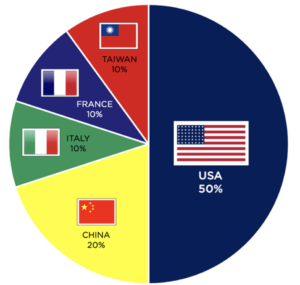 |
| American consumers are voting with their devices — fast. Wi-Fi 7 adoption tripled in a single year. Unlicensed 6 GHz spectrum usage jumped 62% over the same period. That’s routers and everyday devices — phones, laptops, tablets, IoT connected devices — adopting the technology in lockstep, exactly the kind of organic, market-driven uptake that happens when government gets out of the way and lets the industry build to meet consumer demand. | |
| Private capital is following the FCC policy, investing in faster networks to deliver real gains for consumers. Americans’ internet providers didn't wait to be told to invest. They poured capital into upstream network upgrades the moment the spectrum and standards were in place — Xfinity's Wi-Fi 7 upload speeds alone more than doubled year-over-year. Nationally, median download speeds are up 76% and upload speeds have tripled since 2022. This is what growth-oriented spectrum policy looks like in practice: billions in private infrastructure investment, flowing directly from a regulatory decision to open up unlicensed spectrum rather than lock it down for exclusive use. | With Wi-Fi in 6 GHz, U.S. Internet Speeds Are Transformed In the U.S. since 2022: -Download Speeds: +76% FASTER -Upload Speeds: 3X FASTER |
| Lower prices for American families. 90% of cellular data travels over Wi-Fi, and every device that connects over Wi-Fi delivers cost savings directly to consumers’ pockets. In the five years 6 GHz has been available for Wi-Fi, real prices for unlimited mobile plans plummeted 35%, even as data usage kept climbing. Cost is the #1 factor Americans cite when picking a wireless provider, and 6 GHz ensures more providers can compete, which drives down prices for families. | With Wi-Fi in 6 GHz, Americans’ Cell Phone Bills Have Plummeted Mobile Service Prices 2020-2025  The Consumer Price Index (CPI) shows real prices for unlimited mobile service plans declined by 35 percent over the last five years. |
| As AI supercharges demand, more Wi-Fi spectrum will be critical. Chairman Carr’s push to create a new geofenced variable power (GVP) device category will let 6 GHz devices operate outdoors and at higher power than today's low-power indoor and very-low-power classes — unlocking AI, AR/VR, short-range hotspots, automation, and indoor navigation use cases that weren’t possible before. But without more Wi-Fi spectrum, America’s primary wireless highway will not be able to handle the massive increase expected from AI demand. Without Wi-Fi to deliver AI to consumers in their homes and offices, the trove of intelligence will be stuck in remote data centers. America needs a pipeline of Wi-Fi spectrum to meet demand, grow our economy and secure America’s AI leadership. | |
| Advances in Wi-Fi technology advance U.S. national security, too. Chinese-brand hardware holds almost no share of the U.S. 6 GHz and Wi-Fi 7 router market because China hasn’t allocated 6 GHz spectrum – key to the most cutting-edge Wi-Fi 7 capabilities – to unlicensed Wi-Fi. Instead, Beijing reserved the 6 GHz band for state-directed cellular networks, meaning that each new generation of Wi-Fi enabled by 6 GHz keeps China out of U.S. networks and leaves them even further behind the U.S. in the global Wi-Fi market. Smart policy decisions that promote continued Wi-Fi growth and minimize risks from China are the best model to protect national security while powering America’s global technology leadership. |
The bottom line. The data confirms the thesis behind every major 6 GHz decision the Trump Administration has made: unlicensed spectrum, put in the hands of American industry and consumers, drives faster adoption, more investment, and more innovation than any other approach — and it does so while also advancing America’s national security interests.
Read More: Ookla®, “Wi-Fi 7 Grows 4x in the U.S.“
###