
On April 23, 2020, the Federal Communications Commission (FCC) under President Trump’s leadership voted unanimously to allocate spectrum in the 6 GHz band for unlicensed use to account for the rising demand of Wi-Fi.
Since then, the decision has had tremendous positive impacts on the American economy, global standing, and for consumers. Let’s take a closer look at how America is still benefiting from this decision, six years later.
Providing Fast, Reliable Speeds for American Consumers
Millions of Americans rely on Wi-Fi as a part of their everyday life. Whether it is at home, work, or school, Wi-Fi touches nearly everything. In fact, up to 90% of smartphone data consumption happens over Wi-Fi, not cellular networks.
The FCC’s landmark decision to open up the 6 GHz band for unlicensed use allowed Wi-Fi networks to keep up with the growing demand. With American homes averaging more than 20 connected devices, the demand for faster and more reliable connections continues to grow every year. This decision allowed for higher Wi-Fi speeds and lower latencies, without interfering with incumbent services in the 6 GHz band.
Opening up the 6 GHz band for Wi-Fi was a win for millions of American consumers that continue to reap the benefits in 2026.
Boosting the American Economy
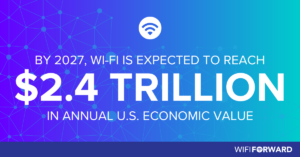
Back in 2020, the FCC decision was originally expected to generate $180 billion in revenue to the American economy over five years. In reality, the gains were much larger than expected. In 2023 and 2024 alone, this decision generated an estimated $870 billion in incremental economic value, and by 2027, it is projected to generate $2.4 trillion!
Putting America First on the Global Stage
The historic move by President Trump’s FCC cemented America’s status as a global leader. Nearly 100 other countries followed our lead and adopted the 6 GHz band for unlicensed use. The big outlier? China.
Wi-Fi is a true American innovation and success story. Adversaries like the Chinese Communist Party (CCP) see Wi-Fi as a threat and seek to restrict the 6 GHz band for the exclusive use of state-sanctioned companies like Huawei, a Chinese telecommunications giant controlled by the Chinese military. While Big Cellular is threatened by Wi-Fi’s success in the 6 GHz band and seeks to take away consumers’ spectrum to resell it back to them, the facts about the tremendous benefits of unlicensed access don’t lie.
National Telecommunications and Innovation Administration (NTIA) Administrator Arielle Roth said it best, “China knows it can’t compete, and for that reason, looks for ways to sabotage the ingenuity that made Wi-Fi a global standard.”
Where Do We Go from Here?
Six years later, the verdict is clear: opening the 6 GHz band for unlicensed use delivered faster Wi‑Fi for millions of Americans, real gains for the U.S. economy, and stronger American leadership around the world. The next step? Protect this successful framework, keep innovation in the lead, and build on this decision so Americans can continue to stay connected and ahead of our adversaries.